Saturday, June 16, 2012

RSA Animate

Under development:
Manual Lima speaks on 
The Power of Network Visualization 
to help navigate 
our Complex Modern World
Source:  http://www.thersa.org/events/video/animate/rsa-animate-the-power-of-networks
Accessed:  June 15, 2012.

Animation helps people visualize lectures.  Watch this video and see how much you can remember.

Here's Changing Education Paradigms 

 adapted from a talk given at the RSA                   


by Sir Ken Robinson        


Here's WHERE GOOD IDEAS COME FROM by Steven Johnson.

Relate the content of these videos:
  • to things you are learning in science this year, 
  • to ways you think and learn, or 
  • compare and contrast their ideas to your own ideas.  
  • Look at other posts on science and animation.  
  • Think about a science concept you would like to animate.   
  • Try your hand at the animation competition.

Here is a link to information on animation competitions:  http://animationideas.com/5-reasons-to-enter-animation-competitions-3/  If the link gets broken for any reason, just search for, "animation competitions," and look over your choices.

RSA animate videos used with creative commons.  RSA Events and the speaker(s) are credited;
The RSA website (www.theRSA.org) is published together with a copy of this policy statement in a prominent position;  The file is not altered and is used in full (the use of extracts under existing fair usage rights is not affected by this condition);  The work is not resold or used for commercial purposes;
A copy of the work or link to its use online is emailed to the RSA Events team.
Find out more:  open access licence..

                                                            ###

Additional Reading
On Sir Ken Robinson's work:  http://www.sirkenrobinson.com

non-RSA text (c) 2012 J S Shipman

Chemistry applet

http://www.webqc.org/mmcalc.php

When using a tool such as this one, be sure you know how to do the automated work.  Understanding what such applets do is essential to science literacy.

Plants not only move, they dance: Award winning La Bloomba!


In memoriam:
http://www.universityofcalifornia.edu/senate/inmemoriam/williamoliverbright.html

Portal to Plant Videos

http://plantvideoreview.blogspot.com/  Examples follow, but there are more.

Ask students to describe what is happening in this film.
Arapidopsis


What is a callus?  After this film, your students will have a good idea.  Let them think about how callus tissue can be used in industry.  Do they think they could grow some callus tissue from a carrot?  Why or why not?

Kenaf Callus Hoedown


Have you just covered  flower structure?  Show how that information is used in the real world.  Also, this film could be used before students design science fair projects (There are mentors at the Botanical Society of America to assist with plant projects).  This film could get students thinking deeply about how science is used to benefit society.

Pollination in Solanum (Tomatoes and Potatoes)


Are you studying cell parts?  Here is a film and song on the Golgi apparatus.  Perhaps your students could create films and songs about other cell parts.

Golgi


Many more available...http://plantvideoreview.blogspot.com/


STEM Quotes and Commentary

Post under development. Check back later.


"Anyone who’s done work in STEM education has a special spot on their bookshelf for copies of the Holy Grails of science ed standards: the National Research Council’s National Science Education Standards and the American Association for the Advancement of Science’s Science for All Americans and Benchmarks for Science Literacy. But as valuable as these documents are, they are getting a little dogeared and in need of being spruced up."
Source: http://ocess.wordpress.com/2010/07/12/conceptual-framework/, Accessed 4-30-2011.

When teaching with research in the classroom, the year Science for All Americans was first published, students were saying, You're not teaching us. Why do we have to do this? Why don't you lecture more?" When I gave them assignments to read in Science for All Americans, the students did a complete turn-around. You are exactly like this book. They then loved the class.

 They started designing and doing experiments. The book helped them with a necessary attitude change.

Unfortunately, at that time, not every college was ready for the research-supported teaching methods. Even today, teachers are being told, "Why don't you lecture more? Why are the students out of their seats? (Getting lab supplies), Why don't you just have them copy things from the book?" Can you believe it? The lesson here is that teachers who adapt research-supported new science education techniques should be supported so that their careers don't get off-track by administrators and parents who are not yet current with the successful new pedagogies. Good teachers were lost by their not getting support as they taught science well.

"Exploring the NAS Framework for New Science Education Standards
"On July 12th, the National Academies of Science released a draft of the Framework for New Science Education Standards. The framework consists of seven chapters and almost 200 pages. It clearly identifies three “dimensions” of science education that must be woven together into standards, instruction and assessment: 1) Disciplinary core ideas in life science, earth and space sciences, physical sciences, and engineering; 2) Cross Cutting Elements including cross-cutting scientific concepts and topics in science, engineering, technology, and society; and 3) scientific and engineering practices.
"Learning progressions are central to the framework. Learning progressions provide a coherent description of how core ideas in science and engineering build throughout K-12.
The framework embraces the mantra, less is more, and states, 'Reduction of the sheer sum of details to be mastered give time for students to engage in scientific investigations and argumentation and to achieve depth of understanding of the material that is included.'"
Source: Eric Brunsell, http://www.teachingscience20.com/2010/07/exploring-the-nas-framework-for-new-science-educatin-standards/
Learning progressions are important. Let's first explain what they are so that everyone reading starts with the same concept in mind:

Botanical Society of America Meetings in Saint Louis: Patterns of Internet Use on the Science Education and Science Literacy Website: read-about-it.


Patterns of Internet Use on the Science Education and Science Literacy Website:


http://www.read-about-it.blogspot.com/
Science education plays a role in effective, "Healing of the Planet." People "wired or wireless," to the internet, are reachable by science educators. Gathering data on this use informs our e-teaching.
Developing/improving e-teaching needs data: how we use internet science sources. Data from 2004-2010 of internet use and reaction to the science literacy and education website, www.read-about-it.blogspot.com are analyzed . Data presented will include: Countries of people frequenting the site, outreach links used most often, popular topics, and how botany topics compare to other topics.
Since science outreach programs are available from numerous sources, including, but not limited to, the Botanical Society of America, NASA, and Plants Cafe, the site www.read-about-it.blogspot.com links users to these and other outreach sites. In addition, it provides discussions and tools both to encourage informal science education, botany and other sciences in the curriculum, science literacy. Such tools, provided here conveniently, foster a knowledgeable public that can act wisely to prevent/alleviate environmental problems.


Source:
http://2011.botanyconference.org/engine/search/index.php?func=detail&aid=259


Conference information:
http://2011.botanyconference.org/engine/search/


Author Contact Information:
Shipman, J

(c) 2011 J S Shipman. BSA has permission to include in abstracts which are quoted here.

What flower is this? The difference between Field Guides, Keys, Cladistics and Asking Experts

Post under development.
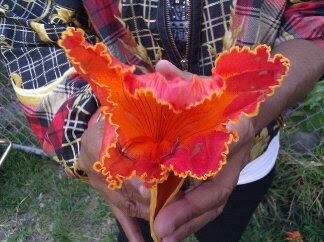


Post under development.


Have you seen a flower like this red sub-tropical one? Do you know what it is? How could you find out?

Maybe you have a friend or relative that can tell you what it is. Maybe you can look in a field guide. Maybe you can use a taxonomic key. Maybe you can use genetic testing or biotechnology.

Scientists today use biotechnological methods to show "pictures of relationships" among organisms. This way of studying organisms genetically and grouping them is a field called cladistics. That may be a new word for many people, because the word itself is relatively new. So using a dictionary to find the meaning can help improve our understanding. It is important to teach students that they do not have to know all the words. Do you know all words? Do doctors and professors?

No one actually knows all words, so, it is important students recognize that and that they realize it is good to learn words that are new to them by using processes like context clues (In this case, we can guess from the context that, "cladistics," has something to do with relationships of organisms) or by looking up words in dictionaries and encyclopedias (and that there are specialized dictionaries and encyclopedias for different fields). It is Joan Beinetti's quote that I like to emphasize to students so they can feel good about themselves, even though they do not know all the words, "No one knows all the words." (Personal communication, 1989).

Being comfortable not knowing is very important to good science. It allows scientists to enjoy finding new information out through experimentation. It is also important to read about what other scientists have done and learn about new words through their work and through tools like dictionaries, whether on-line, electronic, or book formats. So, what is, "cladistics?" Let's have a look.

In Wikipedia (where many students start to look, we find "Cladistics (Ancient Greek: κλάδος, klados, "branch") is a method of classifying species of organisms into groups called clades, which consist of an ancestor organism and all its descendants (and nothing else). ... In the terms of biological systematics, a clade is a single "branch" on the "tree of life", a monophyletic group," (Source: http://en.wikipedia.org/wiki/Cladistics, Accessed March 31, 2011). Did that help? It may have helped some but not others. There are more words that may be unfamiliar. There is no need to be nervous, however.

Let's read more. I found the following historical point interesting because the words the originator chose appear to me much easier to understand (and usually we use the originators words), "Cladistics originated in the work of the German entomologist Willi Hennig, who referred to it as 'phylogenetic systematics' (also the name of his 1966 book); the use of the terms "cladistics" and "clade" was popularized by other researchers. The technique and sometimes the name have been successfully applied in other disciplines: for example, to determine the relationships between the surviving manuscripts of the Canterbury Tales [3, as cited in Wikipedia]," (Source: http://en.wikipedia.org/wiki/Cladistics, Accessed March 31, 2011). Let's get back to the flower and other methods for identifying it.

We've been discussing cladistics, now, we'll look at more traditional Linnaean nomenclature. Wait, look at those two words:
  • nomenclature
  • cladistics
Do you see what I see? I emphasized parts of each word in red. When learning new vocabulary, it is helpful to look at word parts. Earlier we looked at the Greek background of the word, "cladistics." Remember? κλάδος, klados, "branch." Hmmm! Students can think about the word parts as they learn new words. (Scientific literacy involves learning new vocabulary and the related techniques.)

"Most taxonomists have used the traditional approaches of Linnaean taxonomy and later Evolutionary taxonomy to organize life forms. These approaches use several fixed levels of a hierarchy, such as kingdom, phylum, class, order, and family. Phylogenetic nomenclature does not feature those terms, because the evolutionary tree is so deep and so complex that it is inadvisable to set a fixed number of levels," (Source: http://en.wikipedia.org/wiki/Cladistics; Accessed March 31,2011).

Linnaeus was famous for, among other things, binomial nomenclature... a two-name naming system. You know it...genus and specific epithet...genus and species names. These days, people recognize them with organisms familiar to most:

  • Escherichia coli or E. coli
  • Lactobacillus rhamnosis
  • Clostridium difficile
These names are in Latin and follow the grammatical rule for words in foreign languages, that is they are underlined or italicized. There are two words to each name: The genus and the species names.

Taxonomic keys can be used to identify organisms to genus and species based on visible characteristics or other features of the organisms.

The technical literature discusses the difference between cladistics and Linneaen taxonomy. Here are a few examples. (Literacy notes: Remember that some students in any class will have lower, or higher reading levels than others. Some students like a challenge. College students should be capable of reading the journal articles, but, depending on the quality of the library education at their high schools, they may not yet have been exposed to journal articles. Thus, especially in undergraduate classes, it is a good idea to bridge the students up to "college level reading" of the refereed journal articles.)


  • [PDF] Cladistic analysis or cladistic classification [PDF] from cornell.edu E Mayr - Z. zool. Syst. Evol.-forsch, 1974 - courses.cit.cornell.edu... In contrast to the flood of defenses of cladistics published in recent years (by Bigelow, Brundin ...proposes “that the phylogenetic system should be expressed by revision of the traditionalLinnaean system rather than by proposal of a separate classification.”
" Post;Under development
(c)2011 J.S. Shipman