Posts
Posts


Showing posts with label library skills. Show all posts
Showing posts with label library skills. Show all posts
Sunday, November 22, 2009


Wednesday, October 29, 2008
Love to cook? Here's a way to start reading journal articles in science.
Do you love to cook? Or, do some of your students or their parents or grandparents love to cook? Spices provide an interesting and potentially economically interesting link to the technical science literature that you may all find exciting. An introduction to journal articles is perhaps easier if you have another interest, such as cooking, to which you can link new skill in science reading.
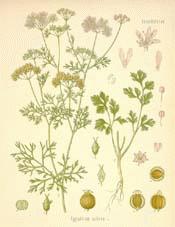
For example, Coriandrum sativum L., the spice coriander and also fresh coriander greens, which in Spanish is, "Cilantro," is the subject of the following primary source article, or..."lab report:"
http://www.hort.purdue.edu/newcrop/proceedings1996/V3-590.html
Take a look at it and see if you can find the various parts that are common among laboratory reports around the world.
So, spices and cooking can provide an introduction to the technical literature. To make the introduction here on coriander relate to other experiences in your life, you might try some foods made with this plant. (Do remember not to eat in the laboratory, however. Follow safety rules.)
Add in some geography: Look at the places where coriander is grown and the countries that use the herb and seeds of coriander in their cuisine.
Coriander/Cilantro Recipes
About Coriander
(c) 2008 J S Shipman
For example, Coriandrum sativum L., the spice coriander and also fresh coriander greens, which in Spanish is, "Cilantro," is the subject of the following primary source article, or..."lab report:"
Coriander Under Irrigation in Argentina
Gustavo Luayza, Roberto Brevedan, and Rosana Palomo
http://www.hort.purdue.edu/newcrop/proceedings1996/V3-590.html
Take a look at it and see if you can find the various parts that are common among laboratory reports around the world.
- Introduction
- What did you find?
- Materials and Methods
- What did they do? What did they use to do it?
- Results
- Are there charts, graphs, photos, verbal descriptions? Explain what you found. (Opinions should not be located in this part of the laboratory report. Are there any here?)
- Discussion and Conclusions (Summary)
- What opinions are expressed (Here, they can be expressed!)? Is public policy suggested? What do the authors say about more experimentation? Are other sources of information used in the discussion?
- Literature Cited
- Did the authors site primary sources? Secondary sources? Personal communication?
So, spices and cooking can provide an introduction to the technical literature. To make the introduction here on coriander relate to other experiences in your life, you might try some foods made with this plant. (Do remember not to eat in the laboratory, however. Follow safety rules.)
Add in some geography: Look at the places where coriander is grown and the countries that use the herb and seeds of coriander in their cuisine.
Coriander/Cilantro Recipes
- http://allrecipes.com/Recipes/Herbs-and-Spices/Spices/Coriander/Main.aspx http://allrecipes.com/Recipes/Herbs-and-Spices/Spices/Coriander/Top.aspx
- http://fooddownunder.com/cgi-bin/search.cgi?q=coriander
About Coriander
- http://www.botanical.com/botanical/mgmh/c/corian99-s.jpg
- http://plants.usda.gov/java/profile?symbol=COSA
- http://plants.usda.gov/java/ClassificationServlet?source=profile&symbol=COSA&display=31
(c) 2008 J S Shipman
Sunday, October 12, 2008
Functional Metabolism
In, Functional Metabolism, Kenneth B. Storey deeply examines metabolism and regulation of carbohydrates, lipids, and amino acids.
Find it in a library near you by going to http://www.worldcat.org/wcpa/oclc/53937951
Feel free to add your comments or reviews. (Remember, this book might take, "Reach Reading™" but it is my opinion it will be worth the challenge!)
Dr. J
Reach Reading is ™ of J S Shipman.
Find it in a library near you by going to http://www.worldcat.org/wcpa/oclc/53937951
Feel free to add your comments or reviews. (Remember, this book might take, "Reach Reading™" but it is my opinion it will be worth the challenge!)
Dr. J
Reach Reading is ™ of J S Shipman.
Wednesday, September 17, 2008
How do you get to Primary Sources from Secondary Sources?
Here is a secondary source article on ants (Click the words).
How would you find primary source articles on the same ants?
Try your hand at this and I will get back later on and update the post.
I don't know if you checked or not, but, you've had some time to look. When I looked, I didn't find anything there except, "plants of the Amazon rain forest," so I went to the primary source abstract. No plants were listed there, either, but, I found the words, "hypogaeic foragers." Those "Reach Reading™" words might help us. For example, knowing the meaning of common prefixes, roots, and suffixes will boost your chances of understanding new words. That is, we can guess from word parts:
Hypo...low, below
Gaeic... Earth, earth
We can also look in on-line or print dictionaries: hypogaeic foragers.
Now that we've checked those meanings, we can use these terms together with Amazon rain forest, to see if we can find anything: http://deposit.ddb.de/cgi-bin/dokserv?idn=967765773&dok_var=d1&dok_ext=pdf&filename=967765773.pdf appears to be a thesis or dissertation from Germany, however, it is written in English and holds a clue: "[Ants known]...to feed on palm oil had broad food spectra (Rettenmeyer[,] 1963; Savage, 1849; Roonwal, 1972; Moffett, 1986)." Looking at the cited articles, we see these complete references:
Moffett, 1986. M. W. Marauders on the Jungle Floor. National Geographic 170:273-286.
Rettenmeyer, C. W. 1963. Behavioral studies in army ants. Univ. Kansas Sci. Bull. 44:281-465.
Roonwal, M.L. 1972. Plant-pest status of root-eating ant, Dorylus orientalis, with notes on distribution and habits (Insecta:Hymenoptera). J. Bombay. Nat. Hist. Soc. 72:305-313.
Savage, T. S. 1849. The driver ants of Western Africa. Proc. Acad. Nat. Sci. Philadelphia. 4:195-200.
The National Geographic article is likely a secondary source. The others look outwardly like they might be primary source, refereed journal articles. We can obtain these articles on-line, or, through interlibrary loan, or, by going to a library that has the journals. I suggest looking at the Roonwal article first, because he talks of roots and plant-pests. But, this article is in the Bombay journal... so, it likely doesn't mention plants of the Amazon that are fed on by ants.
If we have a difficult time finding such articles... on ants eating what plants in the Amazon, it may suggest a research area where we can provide new information. Of course, our literature search has just begun, but, it is an idea worth noting down. (These days you may wish to keep your notes in a spread sheet type file or a database. Personally, I find Microsoft Excel (trademark Microsoft) to be the easiest to rapidly manipulate and to be easy to add new columns and change the data types being stored, if desired. I have also used a number of other systems and file cards and notebooks, or combinations of the above...You have to find your own best system. For young students, this finding-your-own-best-system means learning specific ones your teachers give you, so you can try them out, to later discover what works best for you for note-taking.)
I hope at this point you are catching a feel for the detective-like, puzzle-solving excitement of science... Tracking down ideas in the technical literature so that you can build on the shoulders of the scientists preceding you. Gathering information is one of the steps needed in designing experiments. It allows you the tools to create sound experimental design. One must guard against being biased by the previous work, however. Go and explore. You can search for more primary articles on ants and their plants, or, you can select another science topic that interests you. Remember, the goal is to distinguish between primary and secondary sources, while you read about a science topic of interest to you. (By the way, this skill of finding primary and secondary sources is transferable to other areas such as history, music, math, art and all others.) Enjoy the detective work, and, don't get discouraged by difficult words.
Feel free to add comments on articles that you find, or on your own literature search adventures. If you have questions on primary and secondary sources, be sure to ask those, too.
###
Further Notes:
While looking up, "hypogaeic," to link definitions into the post, I came across this post on a "new" (1903) hypogaeic ant from Texas and have included it for your information: http://www.jstor.org/pss/1535770. When searching the technical literature, "old" literature may provide valuable information. This point is important because students are taught to stay current, and that, too, is important. But, some information is only available in older works. For example, one would not disregard the works of Aristotle or Plato, even though they are old. I mention this because I've seen schools teach students to throw out old references just because they are old. Sometimes that's valid, sometimes, it's not. The important thing is to think deeply about the value. For example, if you were reading an article on heredity from the 1930's and used it as your only source for a paper on heredity, then, you'd be in trouble, because so much new information is known on DNA and heredity since that time. The article below might provide a great comparison and contrast with the earlier article, cited in the secondary source that started this post... style of writing, methods used, similarities and differences in the descriptions, and so on.
The reference to the Texan ants is shown below:
Once the post is updated, I will indicate the update at the bottom of the post: Updated 9-18-2008; Updated 9-20-2008.
How would you find primary source articles on the same ants?
Here is an example of
a primary source article
that came up when searching in PNAS for
ants. It is not on Martialis heureka,
and, not by Christian Rabeling:
http://www.pubmedcentral.nih.gov/articlerender.fcgi?artid=2447876.
Still, it might provide some clues.
The secondary source cited PNAS...Proceedings of the National Academy of Science, so let's look there:
http://www.pnas.org/content/105/14/5287.full?ck=nck. But, we have to go find a library that has this or purchase it to find out if it talks about the new species. It is like detective work.
A ha! Information on, "the 'ant from Mars' single specimen discovered in the Brazilian rainforest represents a sister lineage to all other ants... ARTICLE #08-06187: 'Newly discovered sister lineage sheds light on early ant evolution,' by Christian Rabeling (rabeling@mail.utexas.edu (Source:http://chinese.eurekalert.org/en/pub_releases/2008-09/potn-sif091808.php, 9-19-08)), Jeremy M. Brown, and Manfred Verhaagh." Let's try to find that! Here we go...Here's the link to the abstract: http://www.pnas.org/content/early/2008/09/13/0806187105.abstract. Remember, when looking at a primary source article like this one, to use "reach reading" (trademark, jsshipman). You may have to look up a lot of new vocabulary. But, remember after reading 4 or 5 articles on the same topic, you'll likely learn all that vocabulary and be well on your way to becoming an expert. At the elementary school level, just getting the gist of an article and knowing that such primary sources do exist is the idea. (You might do an activity like circling or listing all the words you don't know...Remember not to write in books or journals unless you personally own them, however.) Don't get frustrated. Remember, just finding such articles and knowing they exist is great at this level. People who win the science fairs on the national level usually use these types of articles even in grades 1-6. On the high school level and junior college level, do try to paraphrase the gist of the article. (Knowing how to do this may come in handy during your life time, in case someone gets sick and you want to look up current research to discuss with your doctor, for example.) Upper class members and graduate students can remember that this is college level reading...and, it takes time to become familiar with such reading, even at these higher education levels. But, you should slug through articles in your research area, until you comprehend them. You might have to stay on the same paragraph for three days, or more, to do that. (Again, don't get frustrated nor discouraged.)
Could you also find primary source articles on the plants used as food, or habitat, or in the environment of these ants? Oh, another detective task! Let's see... First go back to the article and see if any plants are mentioned.a primary source article
that came up when searching in PNAS for
ants. It is not on Martialis heureka,
and, not by Christian Rabeling:
http://www.pubmedcentral.nih.gov/articlerender.fcgi?artid=2447876.
Still, it might provide some clues.
The secondary source cited PNAS...Proceedings of the National Academy of Science, so let's look there:
http://www.pnas.org/content/105/14/5287.full?ck=nck. But, we have to go find a library that has this or purchase it to find out if it talks about the new species. It is like detective work.
A ha! Information on, "the 'ant from Mars' single specimen discovered in the Brazilian rainforest represents a sister lineage to all other ants... ARTICLE #08-06187: 'Newly discovered sister lineage sheds light on early ant evolution,' by Christian Rabeling (rabeling@mail.utexas.edu (Source:http://chinese.eurekalert.org/en/pub_releases/2008-09/potn-sif091808.php, 9-19-08)), Jeremy M. Brown, and Manfred Verhaagh." Let's try to find that! Here we go...Here's the link to the abstract: http://www.pnas.org/content/early/2008/09/13/0806187105.abstract. Remember, when looking at a primary source article like this one, to use "reach reading" (trademark, jsshipman). You may have to look up a lot of new vocabulary. But, remember after reading 4 or 5 articles on the same topic, you'll likely learn all that vocabulary and be well on your way to becoming an expert. At the elementary school level, just getting the gist of an article and knowing that such primary sources do exist is the idea. (You might do an activity like circling or listing all the words you don't know...Remember not to write in books or journals unless you personally own them, however.) Don't get frustrated. Remember, just finding such articles and knowing they exist is great at this level. People who win the science fairs on the national level usually use these types of articles even in grades 1-6. On the high school level and junior college level, do try to paraphrase the gist of the article. (Knowing how to do this may come in handy during your life time, in case someone gets sick and you want to look up current research to discuss with your doctor, for example.) Upper class members and graduate students can remember that this is college level reading...and, it takes time to become familiar with such reading, even at these higher education levels. But, you should slug through articles in your research area, until you comprehend them. You might have to stay on the same paragraph for three days, or more, to do that. (Again, don't get frustrated nor discouraged.)
Try your hand at this and I will get back later on and update the post.
I don't know if you checked or not, but, you've had some time to look. When I looked, I didn't find anything there except, "plants of the Amazon rain forest," so I went to the primary source abstract. No plants were listed there, either, but, I found the words, "hypogaeic foragers." Those "Reach Reading™" words might help us. For example, knowing the meaning of common prefixes, roots, and suffixes will boost your chances of understanding new words. That is, we can guess from word parts:
Hypo...low, below
Gaeic... Earth, earth
We can also look in on-line or print dictionaries: hypogaeic foragers.
Now that we've checked those meanings, we can use these terms together with Amazon rain forest, to see if we can find anything: http://deposit.ddb.de/cgi-bin/dokserv?idn=967765773&dok_var=d1&dok_ext=pdf&filename=967765773.pdf appears to be a thesis or dissertation from Germany, however, it is written in English and holds a clue: "[Ants known]...to feed on palm oil had broad food spectra (Rettenmeyer[,] 1963; Savage, 1849; Roonwal, 1972; Moffett, 1986)." Looking at the cited articles, we see these complete references:
Moffett, 1986. M. W. Marauders on the Jungle Floor. National Geographic 170:273-286.
Rettenmeyer, C. W. 1963. Behavioral studies in army ants. Univ. Kansas Sci. Bull. 44:281-465.
Roonwal, M.L. 1972. Plant-pest status of root-eating ant, Dorylus orientalis, with notes on distribution and habits (Insecta:Hymenoptera). J. Bombay. Nat. Hist. Soc. 72:305-313.
Savage, T. S. 1849. The driver ants of Western Africa. Proc. Acad. Nat. Sci. Philadelphia. 4:195-200.
The National Geographic article is likely a secondary source. The others look outwardly like they might be primary source, refereed journal articles. We can obtain these articles on-line, or, through interlibrary loan, or, by going to a library that has the journals. I suggest looking at the Roonwal article first, because he talks of roots and plant-pests. But, this article is in the Bombay journal... so, it likely doesn't mention plants of the Amazon that are fed on by ants.
If we have a difficult time finding such articles... on ants eating what plants in the Amazon, it may suggest a research area where we can provide new information. Of course, our literature search has just begun, but, it is an idea worth noting down. (These days you may wish to keep your notes in a spread sheet type file or a database. Personally, I find Microsoft Excel (trademark Microsoft) to be the easiest to rapidly manipulate and to be easy to add new columns and change the data types being stored, if desired. I have also used a number of other systems and file cards and notebooks, or combinations of the above...You have to find your own best system. For young students, this finding-your-own-best-system means learning specific ones your teachers give you, so you can try them out, to later discover what works best for you for note-taking.)
I hope at this point you are catching a feel for the detective-like, puzzle-solving excitement of science... Tracking down ideas in the technical literature so that you can build on the shoulders of the scientists preceding you. Gathering information is one of the steps needed in designing experiments. It allows you the tools to create sound experimental design. One must guard against being biased by the previous work, however. Go and explore. You can search for more primary articles on ants and their plants, or, you can select another science topic that interests you. Remember, the goal is to distinguish between primary and secondary sources, while you read about a science topic of interest to you. (By the way, this skill of finding primary and secondary sources is transferable to other areas such as history, music, math, art and all others.) Enjoy the detective work, and, don't get discouraged by difficult words.
Feel free to add comments on articles that you find, or on your own literature search adventures. If you have questions on primary and secondary sources, be sure to ask those, too.
###
Further Notes:
While looking up, "hypogaeic," to link definitions into the post, I came across this post on a "new" (1903) hypogaeic ant from Texas and have included it for your information: http://www.jstor.org/pss/1535770. When searching the technical literature, "old" literature may provide valuable information. This point is important because students are taught to stay current, and that, too, is important. But, some information is only available in older works. For example, one would not disregard the works of Aristotle or Plato, even though they are old. I mention this because I've seen schools teach students to throw out old references just because they are old. Sometimes that's valid, sometimes, it's not. The important thing is to think deeply about the value. For example, if you were reading an article on heredity from the 1930's and used it as your only source for a paper on heredity, then, you'd be in trouble, because so much new information is known on DNA and heredity since that time. The article below might provide a great comparison and contrast with the earlier article, cited in the secondary source that started this post... style of writing, methods used, similarities and differences in the descriptions, and so on.
The reference to the Texan ants is shown below:
- William Morton Wheeler. 1903. Erebomyrma, a new genus of hypogæic ants from Texas. Biological Bulletin, 4:3 (Feb., 1903). 137-148. Published by: Marine Biological Laboratory.
Once the post is updated, I will indicate the update at the bottom of the post: Updated 9-18-2008; Updated 9-20-2008.
Subscribe to:
Posts (Atom)